
Journal ·
British Animals at Christmas: What Hedgehogs, Robins and Red Squirrels Really Do in Winter
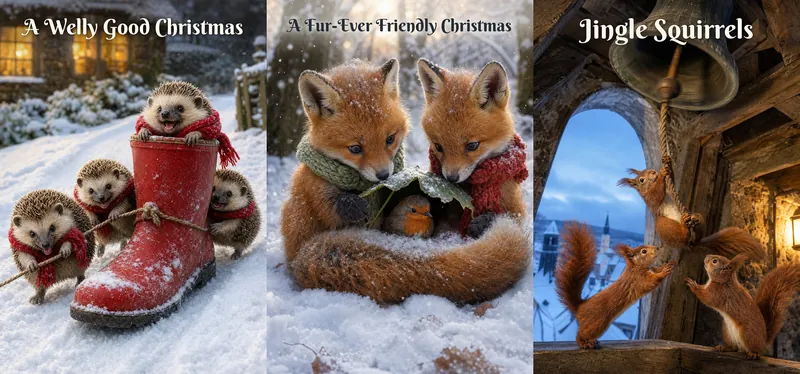
On our Christmas cards, hedgehogs go sledging in wellies, a robin snuggles up with two fox cubs and red squirrels ring the church bells. The real animals are up to something rather different in December. Here's what Britain's favourite Christmas animals actually do in winter, and how you can help the ones in your garden.
Hedgehogs: fast asleep (mostly)
Hedgehogs are one of only a handful of British mammals that truly hibernate. As the weather turns cold and their food (beetles, caterpillars, worms and slugs) gets scarce, they build a nest of dry leaves and grass, usually under a hedge, a shed, a log pile or a compost heap, and settle in from around November until March or April, depending on the weather.
Hibernation isn't simply a long sleep. A hibernating hedgehog lets its body temperature fall close to that of its surroundings and slows its heartbeat and breathing right down, living off the fat it built up in the autumn. Hedgehogs do wake up now and then during the winter, and sometimes move to a new nest, so seeing one out on a mild night in December isn't necessarily a worry. A small hedgehog out in the daytime in winter, though, is often in trouble, and it's worth contacting a local hedgehog rescue for advice.
So our hedgehogs dragging a welly up a Cotswold lane are very definitely up past their bedtime.
How to help hedgehogs in winter
- Leave a hedgehog highway. A gap about 13 cm (5 inches) square at the bottom of your fence lets hedgehogs roam between gardens to find food and mates.
- Leave a wild corner. Piles of leaves, logs and long grass make perfect places to hibernate. Check bonfire piles before you light them.
- Feed the right things. If you put food out in autumn or on mild winter nights, use meaty cat or dog food or specialist hedgehog food with a shallow dish of water. Never give milk or bread.
- Be careful with garden jobs. Check compost heaps and long grass before forking or strimming.
Robins: singing all winter
The robin is the bird on half of Britain's Christmas cards, and for good reason: it's one of the few birds you'll hear singing in the middle of winter. That winter song isn't festive cheer, though. Both male and female robins hold their own territories over winter, and they sing to defend them. Robins can be fiercely territorial and will chase off other robins that stray into their patch.
Robins are also famously tame around people, especially gardeners. In the wild, they follow large animals such as wild boar and deer to snap up insects and worms from the disturbed soil; in a British garden, a person with a spade does the job nicely.
Why are robins on Christmas cards at all? One popular explanation is that Victorian postmen wore red uniforms and were nicknamed "robins", so the bird became a symbol of the Christmas post. That's why our fox cubs sheltering a robin is a bit of a joke: a real robin would probably rather pick a fight than accept a cuddle.
How to help robins in winter
- Robins love mealworms, suet pellets, grated cheese and fruit. They prefer to feed on the ground or from a flat bird table rather than a hanging feeder.
- Keep a bird bath topped up and ice-free on frosty mornings.
- Leave some leaf litter under shrubs, where robins forage for insects.
Red squirrels: awake and hungry
Red squirrels don't hibernate. They stay active all winter, though they spend more time in their dreys (round nests of twigs and moss high in the trees) when the weather is bad. To get through the lean months, they spend the autumn caching food, burying nuts and seeds in the ground and tucking them into crevices, then spend the winter finding them again. Seeds they forget about can grow into new trees.
In winter, a red squirrel's coat becomes thicker and the tufts on its ears grow longer and more noticeable, which is when they look most like the squirrels on Christmas cards. Red squirrels are now rare in much of Britain, having been replaced by the introduced grey squirrel across most of England and Wales. Most of Britain's reds live in Scotland, and in England and Wales there are strongholds in Northumberland and Cumbria, Formby, Anglesey, Brownsea Island and the Isle of Wight.
Our red squirrels ringing the church bells in a Northumberland village are in exactly the right part of the country.
And the rest of our Christmas cast
- Stoats stay active all winter. In colder places, especially the Scottish Highlands, some turn white (ermine), keeping a black tip on the tail, just like our stoats in a red scarf.
- Grey seals have their pups on British coasts in autumn and winter. The pups are born with fluffy white coats, which they moult after a few weeks. If you see one on the beach, keep well back and keep dogs on a lead. See our seal pups on a Cornish slipway.
- Otters don't hibernate either. Their dense, waterproof fur keeps them warm in icy rivers, and they're known for sliding down snowy banks, as on our otter snow fort card.
- Foxes are busy in midwinter, because that's when they look for mates. The eerie screams you hear on a cold January night are often foxes.
Bring them home for Christmas
All of these animals, and plenty more, star in our British wildlife Christmas cards, printed in the UK in packs of 10. And if you'd like them on the wall all year, the Tails of Britain 2027 calendar has badgers wassailing, hedgehogs at the pub and otters punting on the Cam.